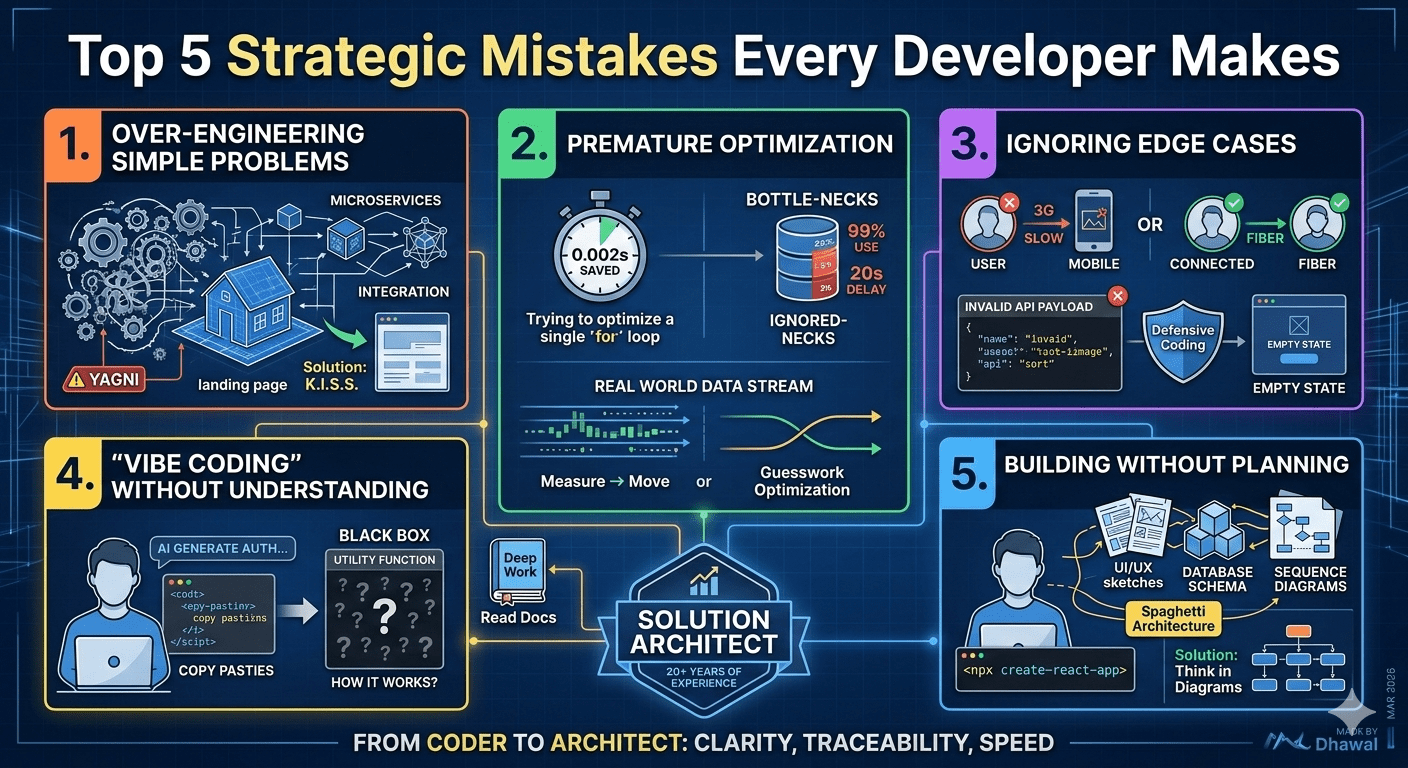
In my two decades of navigating the shifting tides of frontend and architecture, I’ve noticed a recurring pattern. The most expensive mistakes aren't syntax errors or broken APIs—they are strategic fallacies. As developers, we often fall in love with the "how" and lose sight of the "why."
Here is my breakdown of the top five pitfalls that even senior engineers stumble into, and how to architect your way out of them.
Over-Engineering Simple Problems
The "Gold-Plated Hammer" Mistake
Imagine you just need to hang a small picture frame on a wall. Instead of using a simple nail, you go out and buy a heavy-duty industrial drill, laser-leveling sensors, and a specialized mounting bracket designed for skyscrapers.
In coding, this happens when you build a massive, complex system for a task that only requires a few lines of code. You spend weeks building "flexibility" for things that will never happen, making the code much harder for others to read and maintain.
Solution: Keep it simple. Build exactly what is needed today.
Premature Optimization
The "Racing Stripes on a Stationary Car" Mistake
This is like spending hours trying to make your car more aerodynamic by removing the side mirrors to save fuel, but you haven't even put an engine in the car yet.
Developers often spend days making a specific function run 0.001 seconds faster before they even know if that function is the part slowing down the app. You end up with "fast" code that is incredibly confusing and might not even solve a real speed problem.
Solution: Don't fix speed until you have proof that something is actually slow.
Ignoring Edge Cases
The "Sunny Day Only" Mistake
Imagine building a beautiful outdoor cafe but forgetting to put a roof on it because "it’s sunny today." The moment it rains, your business is ruined.
In development, we often code for the "perfect" user who has a fast computer, a stable internet connection, and always types the right information. But in reality, users have slow 3G data, their batteries die, or they accidentally leave fields blank. If your code doesn't plan for these "rainy days," it will crash.
Solution: Always ask, "What is the worst thing that could happen here?" and write code to handle it.
Vibe Coding (Without Understanding)
The "Ikea Furniture" Mistake
This is like putting together a piece of furniture by looking at the picture on the box but ignoring the manual. It might look okay from the outside, but if you missed one internal screw, the whole thing might collapse when someone actually sits on it.
With AI and StackOverflow, it's easy to copy a "vibe" that works. But if you don't understand why that code works, you won't know how to fix it when it breaks. You become a "copy-paster" instead of an engineer.
Solution: Take 5 minutes to read the documentation for any code you didn't write yourself.
Building Without Planning
The "Maze" Mistake
Imagine starting to build a house by laying bricks wherever you feel like it, without a blueprint. Halfway through, you realize you forgot to leave space for the plumbing, so you have to tear down a wall and start over.
Jumping straight into coding without a plan leads to "spaghetti code." You end up going in circles, rewriting the same logic three times because you didn't think about how the different parts of the app would talk to each other.
Solution: Draw it on paper first. 15 minutes of sketching saves 5 hours of frustrated coding.
Conclusion
Being a great developer isn't about how fast you type; it’s about how clearly you think. By avoiding these five pitfalls, you transition from a "coder" to an "architect" - someone who builds systems that are not just functional, but sustainable, scalable, and resilient.